What category of data cable do you need?
Which Category of Data Cable?
A category data cable (usually referred to as a CAT cable) is a network cable classified into a specific category based on its technical performance.
Simply put:
The category indicates:
-
how fast data can be transmitted
-
how much bandwidth the cable can handle
-
how well the cable is protected against interference
What Exactly Does “Category” Mean?
The category is based on official standards (TIA/EIA and ISO/IEC) that specify:
-
maximum data speed (e.g. 1 Gbps or 10 Gbps) – you can measure your internet speed with Speedtest
-
maximum frequency (MHz)
-
level of shielding against interference
-
maximum cable length (usually up to 100 metres)
Generally, the higher the CAT number, the higher the potential performance of the cable.
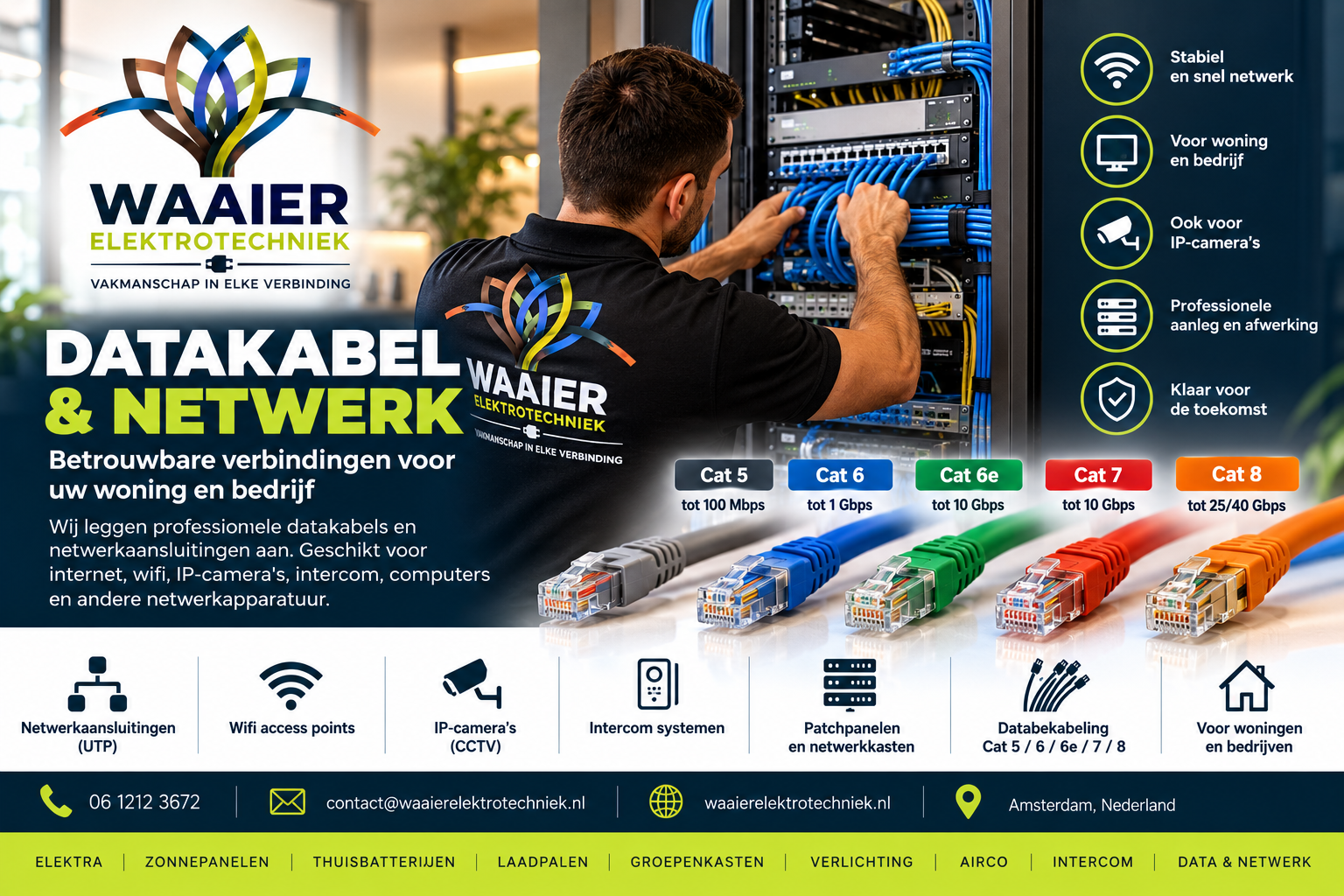
Overview of Data Cable Categories
| CAT | Maximum Speed | Bandwidth | Typical Use |
|---|---|---|---|
| Cat 4 | 16 Mbps | 20 MHz | Older Token Ring networks and legacy networks |
| Cat 5 | 100 Mbps | 100 MHz | Older home networks |
| Cat 5e | 1 Gbps | 100 MHz | Home networks |
| Cat 6 | 1–10 Gbps | 250 MHz | Homes and modern network installations |
| Cat 6a | 10 Gbps | 500 MHz | Offices and new installations |
| Cat 7 | 10 Gbps | 600 MHz | Less commonly used; often |
Hulp nodig met je installatie?
Neem contact op voor advies, een offerte of een afspraak.